A Quiet Arrival Plan for a First-Time Visitor
A quiet arrival plan for a first-time visitor removes guesswork with clear directions, a private way to ask for help and a choice of how to take part.
You send a neighbour the address for a local repair evening, then realise the hall has a side entrance and the group meets in a room behind reception. A quiet arrival plan for a first-time visitor can replace that uncertainty with clear directions, a discreet way to ask for help and room to decide how involved to be.
The focus is not on making an elaborate welcome. It is on giving someone usable information before they set out, and ensuring they can get oriented without having to announce that they are new. Think of the plan as a labelled key: a few useful details open the door, while unnecessary instructions only add weight.
Send useful directions
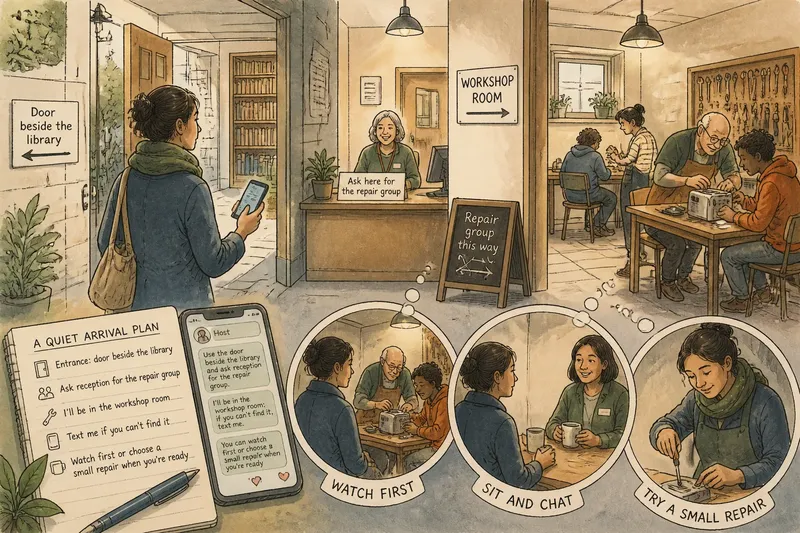
Give the visitor the exact entrance to use, the room or landmark to look for, and any detail that could otherwise cause confusion. “Use the door beside the library; the repair group is in the ground-floor room marked Workshop” is more useful than a venue name alone.
Explain how to identify the gathering once inside. If reception staff can direct people, say what group name to give them. If a corridor forks, name the turn or sign to follow. Avoid assuming that a visitor will recognise a regular’s name or know which parts of a shared building are open to the public.
Keep the message easy to scan. Put the arrival details together, then add the start time and a way to contact the host if something changes. If the venue’s access arrangements are unclear, check with the venue contact rather than passing on a guess.
Offer private help
A first-time visitor may want to ask a practical question without drawing attention in the room. Include a direct contact method, such as a text message to the host, and say what to do if the host is briefly unavailable. This gives the visitor an option without requiring them to approach a group of strangers.
Be specific about what the contact is for: finding the right door, checking that the room has changed, or asking where to put a coat. Avoid promising instant replies if you cannot provide them. A simple alternative, such as asking reception for the group by name, gives the visitor another route.
Privacy also means not turning someone’s arrival into an announcement. Ask before sharing personal details or introducing them with a story they have not offered. Let them choose whether they want a brief introduction, a quiet seat or a moment to look around.
Make choices visible
Once the visitor is in the room, offer a few genuine options rather than assuming they want to join straight away. At a repair evening, they might watch a demonstration, look at the tools, or sit with a drink. Each option should be understandable without specialist knowledge, and declining should not require an explanation.
Say you are inviting a neighbour to a repair evening in a hall with a side entrance and a workshop room beyond reception. You message: “Use the door beside the library and ask reception for the repair group. I’ll be in the workshop room; if you can’t find it, text me. You can watch first or choose a small repair when you’re ready.” The visitor now has a route, a discreet fallback and a choice that does not depend on speaking to the whole group.
Where an activity involves tools or shared equipment, explain how to take part safely and who can help before inviting someone to use it. If the task needs close supervision, offer watching or conversation instead. For safety questions that depend on the equipment or venue, follow the organiser’s instructions and ask a qualified person where appropriate.
Which details matter most?
What should the invitation include?
Name the entrance, the room or landmark, and how to identify the group. Add a contact method for changes or confusion, plus any practical access detail the visitor needs to plan.
How can someone ask for help discreetly?
Offer a direct message to a named host and a clear alternative, such as asking reception for the group. Do not rely on the visitor having to interrupt a conversation or explain themselves publicly.
What if the visitor wants to watch?
Make watching, sitting quietly or taking time to look around valid options. Explain the activity briefly, then let the visitor decide whether and when to join.
What if the plan changes?
Send a direct update with the new entrance, room or contact details as soon as you know them. Do not assume a first-time visitor will hear a change through the regular group.
Check the arrival plan
Before sending the invitation, review the details as if you had never visited the venue. Each check should lead to a clear decision, not merely a tick in a box.
- Entrance: If the named door is open and identifiable, use it; if it is locked or ambiguous, give an alternative entrance and explain how to reach the room from there.
- Room directions: If the room name or signs are clear, include them; if the route has a confusing turn, name the landmark or ask reception to direct visitors.
- Group identification: If reception can recognise the group name, tell the visitor to use it; if not, give a host’s name or another reliable way to identify the gathering.
- Contact method: If the host can check messages during arrivals, share that contact; if not, provide a second person or a staffed place to ask.
- Participation: If the first activity is clear and suitable for a newcomer, offer it as an option; if it needs experience or supervision, offer watching or a simpler alternative.
- Access information: If the venue contact confirms the relevant arrangements, pass on those details; if anything remains uncertain, check before inviting the visitor to rely on it.
A quiet arrival plan for a first-time visitor works best when each detail solves a real uncertainty. Clear directions help someone reach the right room; a private fallback helps them recover if plans shift; and visible choices let them take part at their own pace. The most useful final check is to read the invitation once as a newcomer and remove any instruction that only makes sense to a regular.