How to Sort Donations Before They Reach the Box
A donation box sorting plan helps a community accept useful items, explain what is wanted and choose a responsible destination before storage becomes a burden.
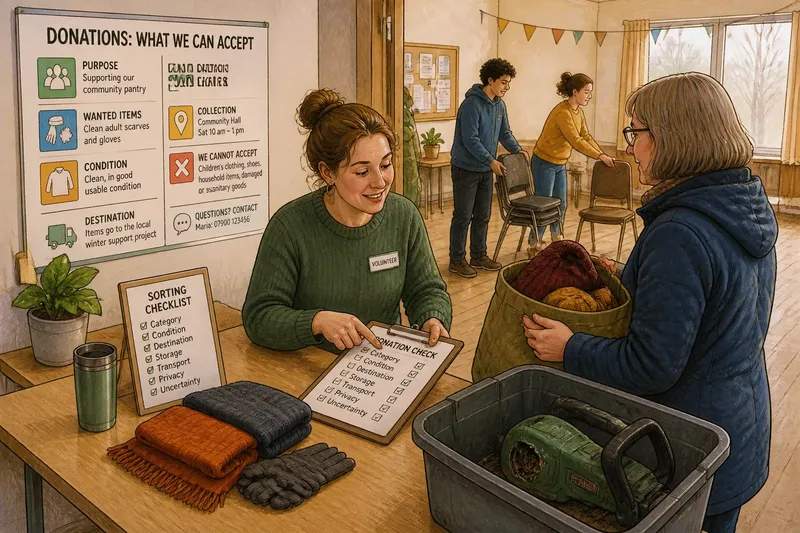
At the community hall, someone arrives with a bag of coats just as volunteers are setting out chairs. A clear donation box sorting plan lets them check what is wanted before the bag is accepted, so the box serves a purpose instead of becoming a waiting room for decisions.
Good intentions do not make every item useful. A donation may be clean and well meant yet unsuitable for the intended recipient, difficult to store or beyond what volunteers can pass on. A modest, visible process helps a group welcome the right offers and decline the rest politely.
Define the collection
Begin with the person or project the collection will serve. A community pantry, a clothing exchange and a repair café need different things. A request for clean adult scarves and gloves is easier to act on than a general appeal for warm clothing.
Before inviting donations, confirm the request with the recipient or partner. Ask what items are useful, what condition they must be in, where they will go and whether the organisation can receive them at the proposed time. If there is no agreed destination, pause the collection until one is confirmed.
Keep the purpose short enough for a sign. State the intended recipient, accepted items, condition, collection place and times, and a contact for questions. Avoid inviting a broad category if the group has room or a route for only a narrow one.
Choose a route first
For each accepted category, decide where it will go and who will move it. The route might be direct handover to a partner, distribution at a community event or use by the project itself. Confirm that the recipient can accept the items before listing that destination on a sign.
Decide what will happen to offers outside the request. The simplest option may be to ask donors to take them away. If the group plans to suggest another local service, check first that it accepts those goods; otherwise, let donors find a suitable route themselves.
A box is like a tray by the front door: useful when everyone knows what belongs there, troublesome when anything can be left on it. Make the box part of a process, not a substitute for deciding what the group can handle.
Set acceptance criteria
Use the same checks for each item in a category. A volunteer can consider whether it matches the request, meets the stated condition and can be stored and transported safely by the group. Keep the choices simple: accept for the agreed route, ask the coordinator, or decline.
Use this short sorting checklist at the point of handover:
- Category: Check whether the item matches the sign; if it does, continue to the condition check, and if it does not, decline it or direct the donor to check another route.
- Condition: Check for the stated signs of usability, such as clean fabric or complete parts; if it meets the request, continue, and if it needs repair or cleaning, decline it unless that work is explicitly part of the project.
- Destination: Check that the named recipient still accepts this category; if confirmed, accept it for that route, and if not, pause acceptance and ask the coordinator.
- Storage: Check that there is a designated space for the item; if space is available, accept it, and if not, stop taking that category until capacity returns.
- Transport: Check that the group has an agreed way to move the item; if one exists, accept it, and if not, ask the coordinator to arrange a route or decline the offer.
- Privacy: Check whether papers or identifying details are attached to a personal item; if present, ask the donor to remove them before handover, and if they cannot be removed safely, decline the item and seek appropriate advice.
- Uncertainty: Check whether a volunteer can answer using the published request; if yes, apply the stated criteria, and if not, hold the decision for the coordinator rather than making an exception at the door.
Volunteers do not need to appraise every object or take on repairs unless those tasks are part of the project and someone has agreed to do them. An item requiring specialist handling should not be passed to an untrained volunteer; ask the relevant organisation or a qualified professional where appropriate.
Make handovers clear
A sign should help a donor decide before carrying an item into the room. Include:
- Purpose: who the collection is intended to support.
- Wanted items: specific types or categories.
- Condition: what counts as suitable for this request.
- Collection details: the agreed place, times and end point.
- Exclusions: what the group cannot accept.
- Contact: who can answer questions or confirm a change.
- Destination: where accepted items will go.
At the handover, a volunteer can point to the request and check that the offer fits. For bulky items or goods that cannot be inspected at the door, agree the collection or drop-off process in advance. Clear wording helps prevent an item from being treated as accepted when it was only left nearby.
When should a group pause?
What should happen when storage is full?
Stop accepting the affected category until space is available or a confirmed onward route has been arranged. Update the sign and tell volunteers, so a donor receives the same answer at the door as on the notice.
How should volunteers decline an offer?
Thank the donor, explain the limit and ask them to take the item away. For instance: “Thank you; we can only accept the items listed here, so please take this one with you.”
What if an item almost fits?
Refer it to a named coordinator only if that person can make a timely decision. If nobody can assess it or the recipient has not confirmed it is useful, decline it rather than leaving it in storage as a possible future fit.
When should a group check with a professional?
Ask the relevant organisation or a qualified professional if a decision depends on specialist handling, safety or local rules. Volunteers should not guess about an item they are not equipped to assess.
A worked handover
Imagine a neighbourhood repair café has confirmed it can use complete hand tools that fit in its cupboard, and its sign asks for clean, usable tools. A resident arrives with a complete, clean adjustable spanner and a bulky garden machine with a missing part. The volunteer checks the sign, confirms that the spanner matches the request and that the café has space and a route to collect it, then accepts the spanner for that handover. The volunteer checks the machine against the same criteria, sees that it is incomplete and outside the listed category, explains the limit and returns it to the resident. The resulting decision is clear: the spanner enters the agreed route, while the machine does not become an unassigned job for the café.
Keep the request current
A recipient’s needs or a group’s available space can change. When that happens, pause new offers, confirm what can still be used and update the sign and volunteer instructions before collection resumes. Remove old notices that still invite items the group can no longer take.
A brief handover note can record the accepted categories, their destinations and any decision awaiting the coordinator. It need not catalogue donors or every object. Its practical purpose is to help the next volunteer apply the same request and avoid accepting goods without a route.
A useful donation box sorting plan makes the boundary visible before a bag is handed over. State what the recipient has asked for, check each offer against the same criteria and stop when storage or transport is no longer available. That small pause can protect both the recipient’s needs and the goodwill behind the gift.