Drop-In or Set Start: Choosing a Rhythm for a Skill Swap
Choose a skill swap rhythm that fits the exchange: compare drop-in and fixed-start formats, then match arrival times to the skills people want to share.
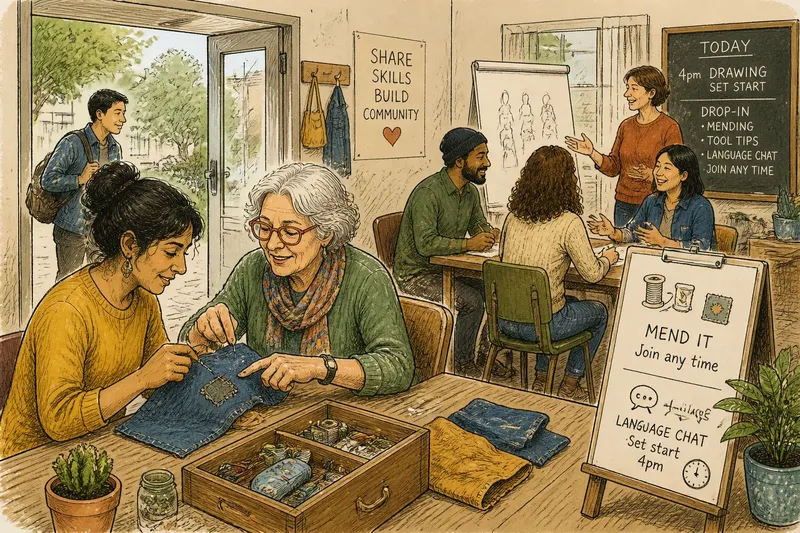
At a neighbourhood hall, one person arrives with a mending kit while another is still finishing work across town. The organiser must decide whether to begin as people come through the door or wait until everyone can gather. Choosing a rhythm for a skill swap shapes who can take part and what kind of learning is possible.
A drop-in session welcomes people throughout an open window; a fixed-start session asks everyone to arrive for a shared beginning. Neither format is automatically more welcoming or more useful. The right choice depends on whether the exchange can be picked up mid-flow, how much context a learner needs, and whether participants are teaching one another or working alongside one another.
1. Match the rhythm to the exchange
Start by describing the activity in plain language. “Bring a small object and learn a basic repair” may suit a rolling format if each repair is self-contained. “Practise a conversation in a new language” may need a shared start so that partners understand the task and agree on how to take turns.
Ask what a participant would miss by arriving late. If the answer is only a brief welcome or a choice of materials, drop-in may work. If the group will build on a demonstration, safety explanation or earlier discussion, a fixed start is usually clearer. A session can also contain both: a short shared opening followed by open practice.
Think of the format as a doorstop, not a timetable carved in stone: it either keeps entry open or gives the group a stable point to begin together. The useful question is not which style sounds more relaxed, but what the skill itself asks people to notice and practise.
2. Use drop-in for repeatable tasks
Drop-in works well when the exchange can be divided into small units. A volunteer might show one visitor how to thread a needle, then help another choose a knot, without either lesson depending on what happened earlier. Simple craft techniques, basic tool orientation at a supervised table, and informal language conversation can often be arranged this way.
It also suits people whose availability is uncertain. Someone may be able to stop by after a shift, bring a child for a short visit, or stay only long enough to ask one focused question. An open arrival window can make the invitation feel less like a commitment to attend an entire class.
To keep the exchange legible, give each activity a visible starting point. A card can name the skill, list what to bring, and show whether a learner can join at any time. Place shared materials where a latecomer can identify them without interrupting a conversation. If a task has a natural pause, such as finishing a seam or waiting for glue to dry, encourage helpers to begin a new round then rather than splitting attention mid-explanation.
Drop-in does require someone to notice arrivals. If every skilled volunteer is absorbed in a long conversation, newcomers may not know where to stand or whether they are interrupting. A greeter can point out the activity choices and make introductions, while a simple sign explains that people may join or watch first.
3. Choose a fixed start for shared foundations
A fixed start is useful when participants need the same foundation before practising. In a beginner drawing session, for instance, the facilitator may introduce how to use charcoal, protect the table and make a few marks before everyone begins. People arriving after that explanation might feel behind or repeat the same questions while others are concentrating.
It can also help when the skill depends on interaction. A storytelling circle, group singing practice or paired role-play benefits from a moment when participants hear the purpose, learn the turn-taking arrangement and meet the people they will work with. Starting together can make the session feel like a shared activity rather than a row of separate mini-lessons.
Set a start time that is clear in the invitation and leave a little room for people to settle in. The first minutes can be used for names, a short explanation and a chance to say what each person hopes to learn. Keep the opening brief enough that the main activity does not feel postponed, but complete enough that late arrivals are not the only people who missed essential context.
If people are likely to arrive late, appoint someone who can welcome them quietly and explain the current activity without stopping the group. This preserves the shared rhythm while avoiding the impression that the door has closed to anyone who could not be there at the beginning.
4. Compare the practical trade-offs
Before choosing, compare the needs of the exchange rather than relying on a general preference for flexibility or structure. A useful planning note can answer these questions:
- Can a learner begin independently? If each participant can start with a short explanation, drop-in is easier to manage. If the skill builds in stages, a shared start may prevent confusion.
- Does the group need to practise together? Pair work, discussion and coordinated activities usually benefit from a common opening. Individual making or troubleshooting can often happen at different times.
- How much help is available? Several helpers can welcome arrivals while continuing demonstrations. With one facilitator, a fixed start may reduce repeated interruptions.
- Can materials be prepared for staggered arrivals? A ready-to-use work surface, labelled supplies and a short instruction card support drop-in. A session that needs a single demonstration setup may be simpler to run as one group.
- What does the venue allow? A room with people coming and going beside a quiet class can be distracting. A separate entrance area or a clear activity boundary may make either format more comfortable.
- Is the skill suitable for informal joining? Some activities require close attention or individual instruction. Follow the relevant equipment guidance and local requirements; where a task calls for specialist supervision, arrange it before inviting people to take part.
This comparison is not a scorecard. One difficulty can matter more than several conveniences: if a newcomer cannot safely or meaningfully join midway through, an open door alone does not make the format inclusive.
5. Try a hybrid without muddling it
A hybrid session has a defined shared start and a later period when people may arrive or leave freely. It is useful when participants need an introduction but the practice can then continue in short, repeatable rounds. Make the two parts distinct in the invitation so that people know whether arriving late means missing the opening or joining a new activity.
Say a community group is arranging a visible mending session. Imagine the organiser plans a brief welcome and demonstration at the start, then invites people to bring one small repair during an open practice window. The expected observable result is that everyone hears the same explanation, while a person who arrives later can still choose a fresh repair and ask for help without requiring the demonstration to begin again.
For a hybrid to work, identify which information belongs in the opening and which can be repeated at a table. Keep shared instructions together, then offer a concise reminder card or a helper who can orient late arrivals. Avoid announcing one start time while implying that the whole session is equally accessible at any moment; say plainly when the group begins and when open joining is possible.
6. Make the invitation match
The wording of an invitation is part of the format. “Drop in between the stated opening and closing times; no need to stay for the whole session” signals flexibility. “We begin together at the stated start time” sets a different expectation. For a hybrid, explain both the opening and the later arrival window.
Include the skill, who might enjoy it, whether materials are supplied, and whether people can watch before joining. If participants should bring an object or wear clothing suitable for an activity, say so in advance. Avoid making a beginner infer from a list of specialist terms that they are already expected to know the skill.
It helps to name the kind of help people can expect. A skill swap might mean a volunteer demonstrates while others practise, or that each attendee brings something they can teach in return. Those are different arrangements. A clear invitation lets people decide whether they want to learn, share, or do both, and whether the session’s rhythm suits them.
7. Questions about timing?
Can people join a fixed-start session late?
They can, if the activity has a quiet way to bring them in, but the invitation should say what they will miss. Arrange a brief welcome or written orientation so a late arrival does not need to interrupt the group to understand the task.
How long should a drop-in window last?
Make it long enough for a visitor to arrive, understand the activity and take part without rushing. The useful span depends on travel, the venue and the task, so state the opening and closing times clearly and describe whether help is available throughout.
What if one skill needs a demonstration?
Schedule the demonstration at a named time, then offer a repeated explanation or a separate practice activity for later arrivals. If repeating it would disrupt the session, use a fixed start or make the demonstration optional rather than implying that drop-in access is continuous.
How can a host tell if the rhythm suited people?
Notice practical signs: whether arrivals knew where to go, whether the facilitator could help without repeatedly stopping, and whether participants had enough time to practise. Ask attendees what made joining straightforward or difficult, then adjust the next invitation and room arrangement accordingly.
8. Review the room, not just the clock
After choosing a rhythm, consider how the space will communicate it. Put the welcome point where it can be seen from the entrance. For a drop-in, display activity names and show which seats or tables are open. For a fixed start, make a clear gathering area so people who arrive early do not have to guess whether to begin.
Notice how noise and movement affect concentration. A lively open table may suit conversation and handwork, while a quiet demonstration needs a place where people can see and hear without crowding. If the venue is shared, coordinate the arrival pattern with other users so that people entering for the skill swap do not mistake another group’s activity for their own.
Finally, treat the first session as a chance to learn about the arrangement, not a verdict on the skill or the people. If a fixed start leaves latecomers stranded, add a welcoming route into the activity. If a drop-in turns into repeated one-to-one explanations, introduce a common opening or clearer activity cards. The best rhythm for a skill swap is the one that lets people understand how to join and gives the exchange room to happen.
For anyone choosing a skill swap format, the most useful decision is often the smallest one: identify the moment when a newcomer needs the group’s shared attention, then build the arrival plan around it. That keeps the invitation honest and makes participation easier to picture before anyone reaches the door.