How to Create a Useful Neighbours’ Shared Record
Create a neighbours’ shared record that helps people find practical local information, choose what belongs in it and keep outdated notes from causing confusion.
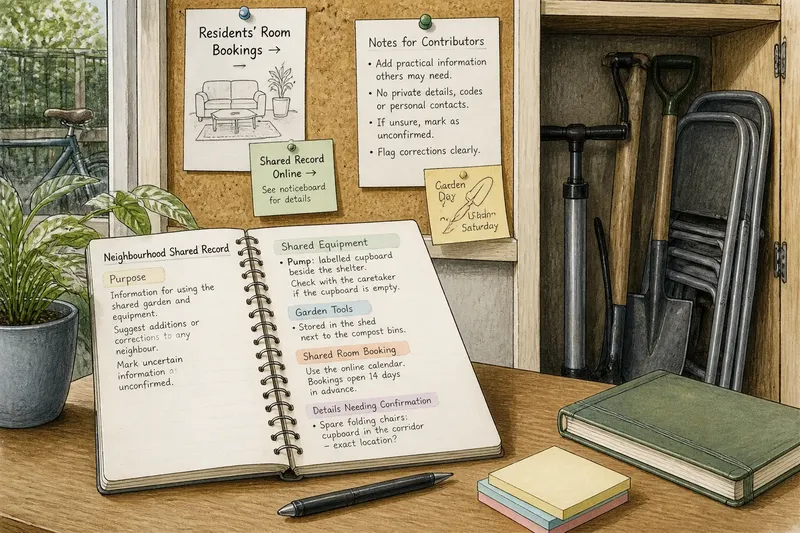
By the postboxes, one neighbour asks where the spare folding chairs are kept; another knows which cupboard holds them. A neighbours’ shared record can make that sort of practical knowledge easier to find, without turning every useful fact into a message that gets lost in conversation.
It works best as a small, focused resource: a notebook, noticeboard page or searchable online document for information neighbours are likely to need again. Decide what it is for, who can use it and how an uncertain or outdated entry should be handled.
Choose a clear purpose
Begin with a recurring question, such as how to book the residents’ room or where shared gardening tools belong. A record designed around a few common needs is easier to use than one intended to collect everything about a neighbourhood.
Write a short purpose statement, for example, “Information for using the shared garden and its equipment.” This gives contributors a way to decide whether an entry belongs. Individual complaints, private contact details and information about someone’s routine should not go on a record that many neighbours can access.
Ask likely users what they would look up. If the answers concern one-off plans, a conversation may be more suitable. If the same practical question comes up repeatedly, a shared note may save people from having to ask again.
Choose an accessible format
A paper notebook or noticeboard page can suit a common room where residents pass regularly. A shared online document or message group may work better when neighbours need to contribute from different places. Consider who can access the format, whether entries can be searched and who is able to make corrections.
For a mixed group, a noticeboard can point to the online record without displaying information that should remain private. Keep any access instructions general; do not post door codes, personal phone numbers or details that could expose someone’s home or routine.
Think of the record as a labelled drawer: it is useful when people know what belongs inside and can find the right section. Give it a plain name and put it where intended users will look, such as beside a room-booking notice or in a clearly named shared folder.
Make entries easy to use
Start with a brief note explaining the record’s purpose, who may suggest additions and how to flag a correction. Organise information by subject, not by the order in which people submitted it. Possible headings include:
- Shared rooms and equipment
- Garden and outdoor spaces
- Local services
- Regular arrangements
- Details needing confirmation
For each entry, include the practical detail someone needs to act and, where appropriate, a way to check whether it is still current. Avoid collecting personal details that are not needed. Mark uncertain information as unconfirmed rather than allowing a guess to appear settled.
Say you are adding a note about a pump kept in a shared bicycle shelter. The starting information is that neighbours need to know where the pump is and that its location might change. You enter “Pump: labelled cupboard beside the shelter” under “Shared equipment”, then add “Check with the caretaker if the cupboard is empty.” The resulting note gives a neighbour a place to look and a next action if the pump is not there, without implying that its location can never change.
Check what belongs?
What should a neighbours’ shared record include?
Include practical details that several neighbours may need more than once, such as how to reserve a common room or where shared equipment is stored. Keep confidential information and personal disputes out of a broadly accessible record.
Should the record be on paper or online?
Paper can be easier for people who use a shared building but not the same apps; an online document can make remote editing and searching simpler. Choose the format the intended users can reach and the group can keep organised.
How should an outdated entry be corrected?
Make the change visible: replace an obsolete paper page or add a clear update to the relevant online entry. If the old information could lead someone to take the wrong action, mark it as no longer current rather than leaving two conflicting versions.
What details should stay private?
Leave out door codes, personal contact details and notes about when someone is away unless there is a clear, agreed need to share them. When privacy or access rules are uncertain, ask the building manager or another appropriate qualified adviser before posting sensitive information.
Review notes with care
Use an existing residents’ meeting or noticeboard refresh to look for entries that are duplicated, unclear or no longer accurate. Ask someone with direct knowledge to confirm a doubtful detail before changing it. Make it easy for neighbours to suggest a correction without turning the record into a judgement about who was right.
Apply a simple decision rule when checking an entry:
- If an entry is clear and still useful, keep it; if not, rewrite it in plain language or remove it.
- If the person or source responsible for a detail can confirm it, keep the confirmed version; if not, mark it unconfirmed or take it down.
- If two entries conflict, check which one is current; if that cannot be established, flag the disagreement rather than choosing a version by guesswork.
- If an entry contains personal information that is not needed, remove it; if the group has a genuine need for it, agree who can access it before adding it back.
- If a paper notice is hard to read or has several corrections, replace the page; if it remains clear, make the correction legibly in place.
- If an online note is buried in replies, move the current information to a clear heading; if the group cannot do that, post a plainly titled update where members can find it.
A neighbours’ shared record is most useful when it answers a small set of real questions and leaves people able to correct what changes. Start with one recurring need, choose a format the neighbours who need it can reach, and add only information that helps them decide what to do next.